The Bankruptcy of Bruno's Farming and Dairy Business
The Eight Mountains: A NovelThe Bankruptcy of Bruno's Farming and Dairy Business marks the collapse of Bruno's attempt to make a permanent livelihood from the mountain life he valued above alternatives. The farm began as a practical ambition, sustained by intensive work and care for the animals, but the cheese enterprise could not cover its debts. As financial pressure sharpened the difference between Bruno's commitment to the mountain and Lara's willingness to adapt, the business's failure became inseparable from the breakdown of their partnership.
From mountain refuge to working farm
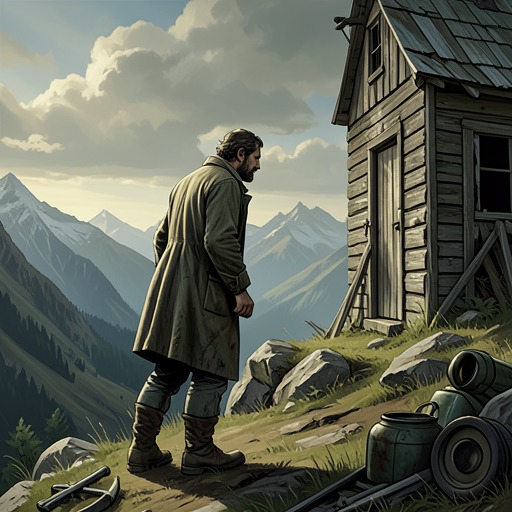
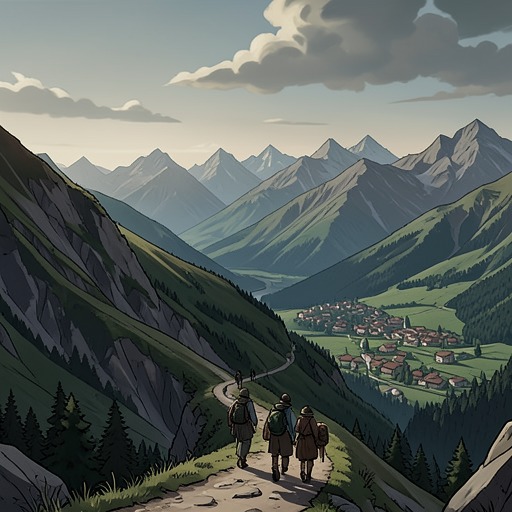
Bruno's business took shape after he spent time rebuilding Barma with Pietro. He had saved money to buy his uncle's farmstead, used his savings for a down payment, and hoped to borrow the balance from a bank. The months at Barma had served as a test of whether he could manage the work. His plan was to rebuild the farmstead's huts, acquire cattle, and have the farm operating within a few years. The project joined an attachment to mountain life with a specific economic undertaking: buying property, securing credit, restoring buildings, and raising livestock.
The farmstead eventually comprised a house, stable, and storeroom, restored with stone walls and roofs. Though the buildings recalled an earlier Alpine farm, they now served a modern agricultural enterprise. Bruno's authority there was tangible: he was its master, and the first toast after Pietro and Lara arrived was made standing at the stable threshold, with the cows growing accustomed to the mountain. But the restored buildings and the promise of a working farm did not mean that the undertaking would be financially secure.
Labor, production, and the first sale
Bruno built the operation around painstaking daily labor. He insisted on milking the cows by hand, believing this gentler method suited animals that could be startled easily. Each cow took about five minutes to yield a liter, so milking twelve cows required an hour and the whole herd about two and a half hours. He rose before daylight, worked every day of the week, and treated the task as a ritual he would not delegate. His care for the herd was real, but it also tied the business to his own continuous presence and effort.
Lara carried a substantial share of the work. She brought Bruno coffee and biscuits at seven and took the herd out to pasture twice a day. Bruno combined about 150 liters of fresh milk with the same quantity from the previous evening, skimmed the cream, heated the mixture, and added rennet. By nine, the curd was ready to strain and press into wooden molds. The three hundred liters produced five or six cheeses, about thirty kilos of toma. He made butter from the cream, then cleaned the equipment and stable; after a short rest, the work resumed with the afternoon milking and another trip to pasture.
The production process depended on care and experience but did not guarantee a predictable result. Bruno was never certain whether the cheese would form properly or turn out well. He followed what he had been taught and looked after the cows, while the outcome still seemed beyond his control. The labor-intensive routine and uncertainty of production stood beside the demands of running a business: making enough money, servicing loans, and getting the product to buyers.
The first delivery gave the enterprise a concrete connection to the market. In late July, Lara took the first batch that had matured for six weeks down to the village on a mule Bruno had acquired for the job. Its wooden packsaddle carried twelve cheeses weighing sixty kilos in total. Bruno kissed Lara, patted the mule, and stayed behind to clean the stable; he had decided, as he had during the earlier building work, that transport was not his task. In Grana, a buyer inspected each cheese, weighing it and recording the figures in a ledger and on a receipt. The receipt recorded the couple's first earnings. This was a milestone, but the money from sales would not keep pace with the costs of the farm.
Debt and the conflict over alternatives
By the summer Pietro returned after an absence, the farm had also become a business in the red. Lara explained that cheese-making income did not cover the mortgage repayments. Money passed through their hands without leaving anything to reduce the debt, and winter brought further costs, including rent for stables. They had taken out another loan to pay earlier debts. The strain was not simply a bad season: the enterprise's financial structure left them borrowing again while struggling to meet existing obligations.
Lara tried to improve the sales side by cutting out the distributor and selling directly to shopkeepers. This avoided the middleman but added work. Twice a week she drove down to make deliveries, leaving their young daughter, Anita, with Pietro's mother in Grana and Bruno to manage the farm alone. Hiring help was not a workable solution for them, since the added expense would have erased the benefit. The direct-sales effort therefore shifted more labor onto Lara without removing the underlying pressure of debt and costs.
The partners disagreed over whether the farm could be saved by changing course. Lara believed they had once had options: sell the cows, rent out the farmstead, and find other jobs until their finances improved. She was willing to take ordinary work, including shop or restaurant work; she thought Bruno could find employment at a building site, a dairy processing unit, or on the ski slopes. Bruno, in her view, could not imagine an alternative life. Their arguments about money exposed a deeper mismatch: Lara treated financial survival as a problem that required choices, while Bruno resisted separating his future from the mountain farm.
Closure and aftermath
In autumn 2013, Bruno declared himself bankrupt, shut down the agricultural business, and handed the farm keys to the bailiff. Lara went to live with her parents with Anita. The account preserves two versions of how their separation came about: according to Pietro's mother, Lara had decided to leave Bruno and he had given up; Bruno's own later account was that he had made the mistakes and had no one else to blame. The difference does not alter the outcome, but it shows how the business's collapse was understood both as a financial failure and as the end of a shared life.
Pietro's mother feared that Bruno had lost everything and was now alone. Her concern prompted Pietro, while in Kathmandu, to telephone his old friend—something he had not done before from Nepal. The bankruptcy thus altered not only Bruno's livelihood but also the pattern of his relationships: his isolation became serious enough to draw Pietro back into direct contact.
Later, Bruno described the failure as a consequence of trying to become a businessman despite knowing little about money. He imagined that he should instead have repaired a small place, brought four cows up, and lived that way from the beginning. He had come to understand his strength as the ability to live in the mountains by himself, not to build a larger enterprise. That conclusion does not erase the earlier work, the care invested in the herd, or the years of debt. It gives the collapse its lasting significance: Bruno's attachment to mountain life survived, but the attempt to turn that attachment into a business with a shared future did not.